

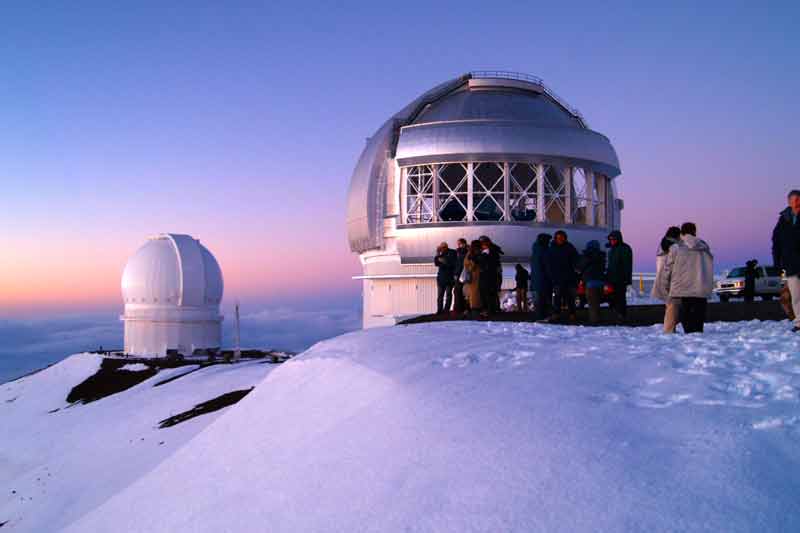
Quick answer
Family stargazing at Mauna Kea centers on the Visitor Information Station at 9,200 feet, where children ages six and up typically tolerate the altitude well during evening telescope programs. Summit access above 13,000 feet is not recommended for children under sixteen due to thin air and rapid oxygen desaturation. The site is open daily from 09:00 to 21:00, with stargazing best after twilight ends around 19:30 to 20:00 depending on season.
Mauna Kea holds thirteen of the world's most powerful telescopes, but none are open to the public. What families experience instead is the Visitor Information Station, positioned at the highest elevation most children should attempt on the mountain. The station sits two miles below the summit and provides loaner telescopes every clear evening—conditions permitting—staffed by volunteers who point out planetary detail, star clusters, and deep-sky objects invisible from sea level. The elevation difference matters more than the numbers suggest. At 9,200 feet, atmospheric pressure drops enough that children feel winded after minor exertion, but acute mountain sickness remains uncommon in healthy kids over six. Above 10,000 feet, oxygen saturation falls rapidly, and the summit environment—where research observatories sit—routinely triggers headaches, nausea, and disorientation even in acclimatized adults. Four-wheel-drive rental agreements explicitly prohibit taking children under sixteen past the mid-level station, and summit tour operators enforce the same threshold. A mauna kea stargazing tour with kids works best when framed as a Visitor Information Station experience rather than a summit expedition. Families typically arrive between 17:30 and 19:00 to acclimatize before dark, spending the fading daylight at the station's exhibits on Hawaiian astronomy and the mountain's geology. Once civil twilight ends and the Milky Way emerges, volunteers set up eight-inch Dobsonian reflectors on the lawn and guide children through Saturn's rings, the Orion Nebula, and whatever planets dominate the evening sky. The air is cold year-round after sunset—temperatures fall into the 30s Fahrenheit even in summer—and wind on the exposed slope cuts through cotton layers within minutes. What children retain from the visit depends less on telescope magnification than on preparation. Kids who arrive expecting a warm observatory tour often struggle with the cold and thinness of the air, while those briefed on the environment treat the discomfort as part of the adventure. The mountain's reputation as a stargazing destination is accurate, but the family-accessible version unfolds at mid-elevation, not the summit, and the experience hinges on managing altitude and temperature rather than finding the right viewing program.
“At 9,200 feet, the station provides the clearest skies most children will ever see without crossing into altitude that poses real risk.”
Best Time for a Mauna Kea Stargazing Tour With Kids
The best arrival window for families is 17:30–20:30, which allows children sufficient time to acclimatize to the high altitude before observing the night sky. Arriving before sunset ensures a safer transition and preparation for the conditions that follow once twilight ends.
Summer months
High volumeClear skies, 30°F–40°F
Warmer nighttime temperatures make stargazing easier for children.
Winter months
Moderate volumeHigher chance of snow, 20°F–35°F
Wind and cold require significant preparation for younger visitors.
Shoulder season (Apr/Oct)
Low to moderateStable, mild, 25°F–40°F
These months often offer the most consistent weather patterns for families.
Verdict: The best time to visit with children is during the shoulder months of April or October, arriving within the 17:30–20:30 window to ensure proper altitude acclimatization.
Family Logistics for a Mauna Kea Stargazing Tour With Kids
Visiting Mauna Kea requires careful planning due to high-altitude conditions and limited infrastructure. Safety and acclimatization are the primary considerations for families planning a visit.
Altitude safety
Children under 16 are generally discouraged from traveling to the summit due to the risk of altitude sickness. Consult a pediatrician before bringing young children to high elevations.
Strollers
Strollers are not practical on the rocky, uneven terrain surrounding the visitor area. Use a high-quality child carrier if you must transport young children across the volcanic landscape.
Facilities
Public facilities are extremely limited at high elevations. Ensure children use restrooms at lower altitudes before beginning the ascent, as services become sparse beyond the visitor station.
Environment
The summit area lacks climate control, medical support, and standard amenities. Prepare for rapid temperature drops and thin air by monitoring children closely for signs of fatigue, nausea, or dizziness.
Getting to Your Mauna Kea Stargazing Tour With Kids
Mauna Kea is located on the Big Island of Hawaii, accessible via the Mauna Kea Access Road. Reaching the high-altitude areas requires driving a vehicle capable of navigating steep, unpaved sections and managing significant elevation changes.
Saddle Road (State Route 200) to Mauna Kea Access Road
Mauna Kea Access Road from Hilo
Mauna Kea Access Road from Kona
Mauna Kea Stargazing Tour With Kids: Opening Hours
The Mauna Kea Visitor Information Station operates with consistent daily hours to accommodate guests. Families should plan their schedule according to these published times.
| Monday | 09:00–21:00 | |
|---|---|---|
| Tuesday | 09:00–21:00 | |
| Wednesday | 09:00–21:00 | |
| Thursday | 09:00–21:00 | |
| Friday | 09:00–21:00 | |
| Saturday | 09:00–21:00 | |
| Sunday | 09:00–21:00 |
Admission Fees for a Mauna Kea Stargazing Tour With Kids
Access to the Mauna Kea Visitor Information Station does not require an entrance fee. Visitors may arrive to explore the area without paying for admission.
There is no entrance fee to access the site, though visitors should budget for transportation and guided tour services if choosing to book with an external operator.
Preparation Checklist for a Mauna Kea Stargazing Tour With Kids
Pack for extreme temperature swings and high altitude when bringing children to Mauna Kea's summit.
-
Reserve a guided tour in advance — Tours fill quickly and ensure safe, age-appropriate acclimatization at 13,796 feet.
-
Pack insulated jackets for every family member — Summit temperatures drop to 30–40°F even in summer, with strong winds.
-
Bring multiple thermal layers per child — Kids lose body heat faster than adults at high altitude.
-
Pack snacks and extra water bottles — Altitude increases dehydration risk and kids may not recognize thirst cues.
-
Bring flashlights with red filters — White light ruins night vision needed for stargazing and telescope work.
-
Wear closed-toe shoes with good traction — Volcanic terrain is uneven and sharp; sandals are unsafe for children.
Check availability
FAQs: Mauna Kea Stargazing Tour with Kids
Everything you need to know about mauna kea stargazing tour with kids