

Quick answer
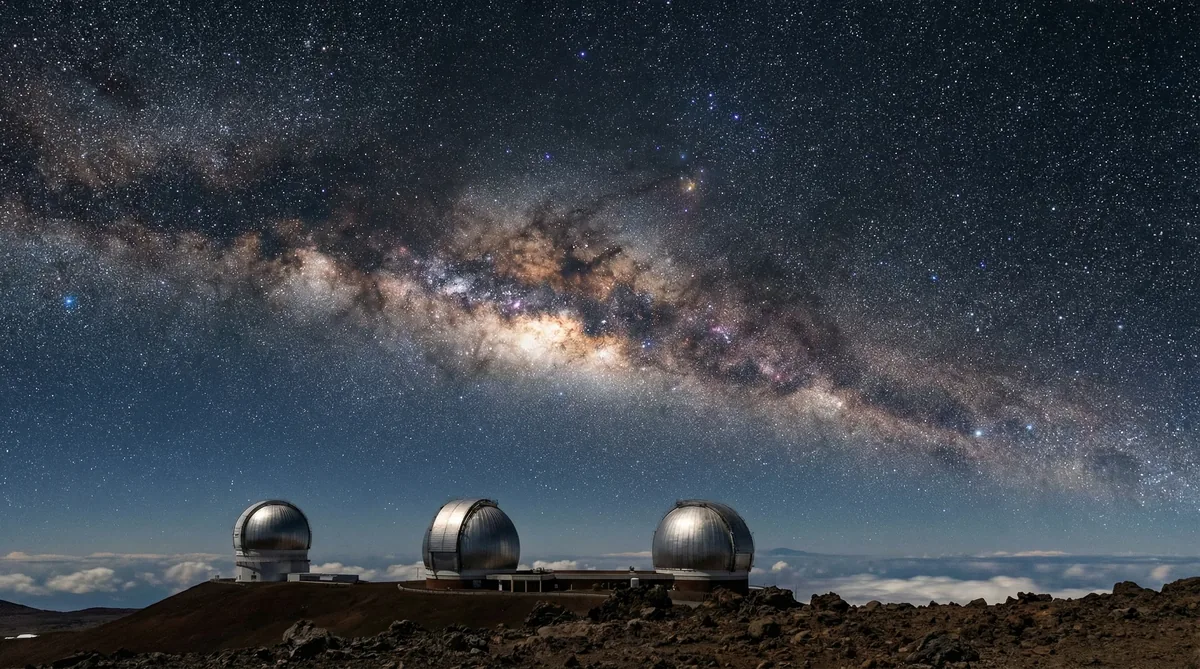
The mauna kea stargazing forecast combines satellite cloud-cover imaging, atmospheric seeing indices, and moon illumination calendars to predict optimal observation windows. Professional observatories on the summit reference the MKWC (Mauna Kea Weather Center) hourly forecasts and CFHT seeing monitors, which track atmospheric turbulence in arc-seconds. Clear nights occur most reliably from May through September when trade wind inversion layers stabilize below 8,000 feet, though winter months offer darker skies during new moon phases despite higher cloud risk.
Mauna Kea's summit receives fewer than 200 cloudy nights per year, but the forecast margin between excellent and unusable conditions can close in under two hours. Atmospheric seeing—the steadiness of starlight as it passes through turbulent air—varies with jet stream altitude, and a forecast that shows zero cloud cover can still deliver poor resolution if wind shear above 30,000 feet scrambles incoming photons. The MKWC publishes hourly updates that parse satellite infrared imagery, radiosonde balloon data, and ground-station humidity readings into a composite clarity score. Visitors who cross-reference this with the Clear Sky Chart's transparency and seeing columns gain the predictive edge observatories use to schedule multi-hour exposures. Seasonal inversion behavior defines the mauna kea stargazing forecast reliability window. Trade winds push moist Pacific air against the island's eastern flank from April through October, creating a stable cloud deck between 6,000 and 8,000 feet that rarely breaches the summit. During these months the forecast confidence interval tightens, and same-day predictions hold accuracy past 85 percent. Winter brings Kona lows—cyclonic systems that disrupt the inversion and pull moisture to summit altitude—raising cloud probability but also dropping precipitable water vapor to levels that enhance infrared transparency. Moon phase overlays this pattern: new moon windows in July and August pair inversion stability with Milky Way galactic center visibility, while December and January new moons offer the darkest skies if storm tracks permit. Optical depth and seeing indices separate casual stargazing from astrophotography-grade conditions. The CFHT seeing monitor reports real-time turbulence in arc-seconds, with values below 0.6 indicating exceptional steadiness for planetary imaging and values above 1.2 suggesting wide-field photography only. Forecasters also track the tropopause height—the boundary where temperature inversion occurs—which when positioned above 45,000 feet correlates with minimal scintillation. Visitor-accessible tools like the MKWC's 48-hour cloudiness percentage and Windy's jet stream overlay let non-professionals approximate the same decision matrix observatories use, turning the forecast from a binary clear-or-cloudy guess into a graded assessment of transparency, steadiness, and humidity that matches your equipment and targets to the night's measurable atmospheric state.
“Mauna Kea's summit receives fewer than 200 cloudy nights per year, but the forecast margin between excellent and unusable conditions can close in under two hours.”
Seasonal and Daily Mauna Kea Stargazing Forecast Windows
The most stable stargazing conditions on Mauna Kea occur during the shoulder seasons when atmospheric turbulence is minimized. Aligning your visit with these periods ensures clearer views of celestial objects.
April to May
Moderate crowdsClear skies, 30°F to 45°F
Stable air masses provide high-quality visibility for deep-space observation.
September to October
Low crowdsDry conditions, 30°F to 45°F
Reduced moisture in the atmosphere allows for sharper resolution of constellations.
Winter Months
High tourist volumeFrequent storms, 25°F to 40°F
High altitude snow and cloud cover can disrupt access and viewing windows.
Daily Arrival
Moderate to high—
Per our arrival recommendation, ensure you arrive between 09:00–20:30, at least 30 minutes before sunset, to acclimatize and secure your space.
Verdict: The optimal window for stargazing is Tuesday to Thursday during the months of April or October, arriving by 09:00–20:30.
Mauna Kea Stargazing Forecast and Operational Hours
The Mauna Kea Visitor Information Station operates on a consistent daily schedule to provide access to the facility and grounds.
| Monday | 09:00–21:00 | |
|---|---|---|
| Tuesday | 09:00–21:00 | |
| Wednesday | 09:00–21:00 | |
| Thursday | 09:00–21:00 | |
| Friday | 09:00–21:00 | |
| Saturday | 09:00–21:00 | |
| Sunday | 09:00–21:00 |
Logistics for Arriving at Your Mauna Kea Stargazing Forecast Location
The Mauna Kea Visitor Information Station is located off Mauna Kea Access Road on the Big Island of Hawaii. Visitors typically approach by driving from Hilo or the Kona coast via Daniel K. Inouye Highway.
Mauna Kea Access Rd from Daniel K. Inouye Highway
4WD vehicle to summit
Private tour transport
Essential Preparation for Your Mauna Kea Stargazing Forecast Visit
High-altitude stargazing demands careful preparation for cold, thin air, and remote conditions.
-
Check weather and cloud forecasts — Summit conditions change rapidly and can obscure visibility.
-
Acclimatize at the Visitor Information Station — Spending 30 minutes at 9,200 feet reduces altitude sickness risk.
-
Pack insulated layers and winter gear — Temperatures drop below freezing after sunset, even in summer.
-
Bring a flashlight with red filter — White light ruins night vision and disrupts other observers.
-
Fill your gas tank in Hilo — No services exist on the mountain and cell coverage is unreliable.
-
Avoid alcohol and heavy meals beforehand — Digestion and dehydration worsen symptoms at 13,800 feet.
-
Confirm road conditions and closures — Ice, snow, or cultural events can close the summit access road.
Etiquette and Guidelines for Your Mauna Kea Stargazing Forecast
Mauna Kea is a sacred site for Native Hawaiians and a protected environmental zone. Visitors must observe cultural protocols and conservation rules to preserve the summit's integrity.
Do
- Respect all cultural sites and stay on designated paths
- Keep voices low and avoid excessive noise near other stargazers
- Pack out all trash and leave no trace
- Dim headlights and use red-filtered flashlights only
- Allow adequate time for altitude acclimatization before observing
- Yield to observatory vehicles on the access road
Don't
- Don't remove rocks, plants, or any natural materials from the site
- Don't use white lights or camera flashes during observation hours
- Don't enter restricted areas or approach observatory buildings
- Don't bring drones or operate them anywhere on the mountain
- Don't litter or leave food waste that attracts animals
- Don't ignore altitude sickness symptoms or push through discomfort
Check availability
Frequently asked questions about Mauna Kea stargazing forecast
Everything you need to know about mauna kea stargazing forecast